Keep your hardware bench online, controlled, and ready to run.
A compact hardware node with switched USB, power control, serial capture, GPIO triggers, local control surfaces, and optional cloud coordination, so your bench stays available even when your laptop is closed.
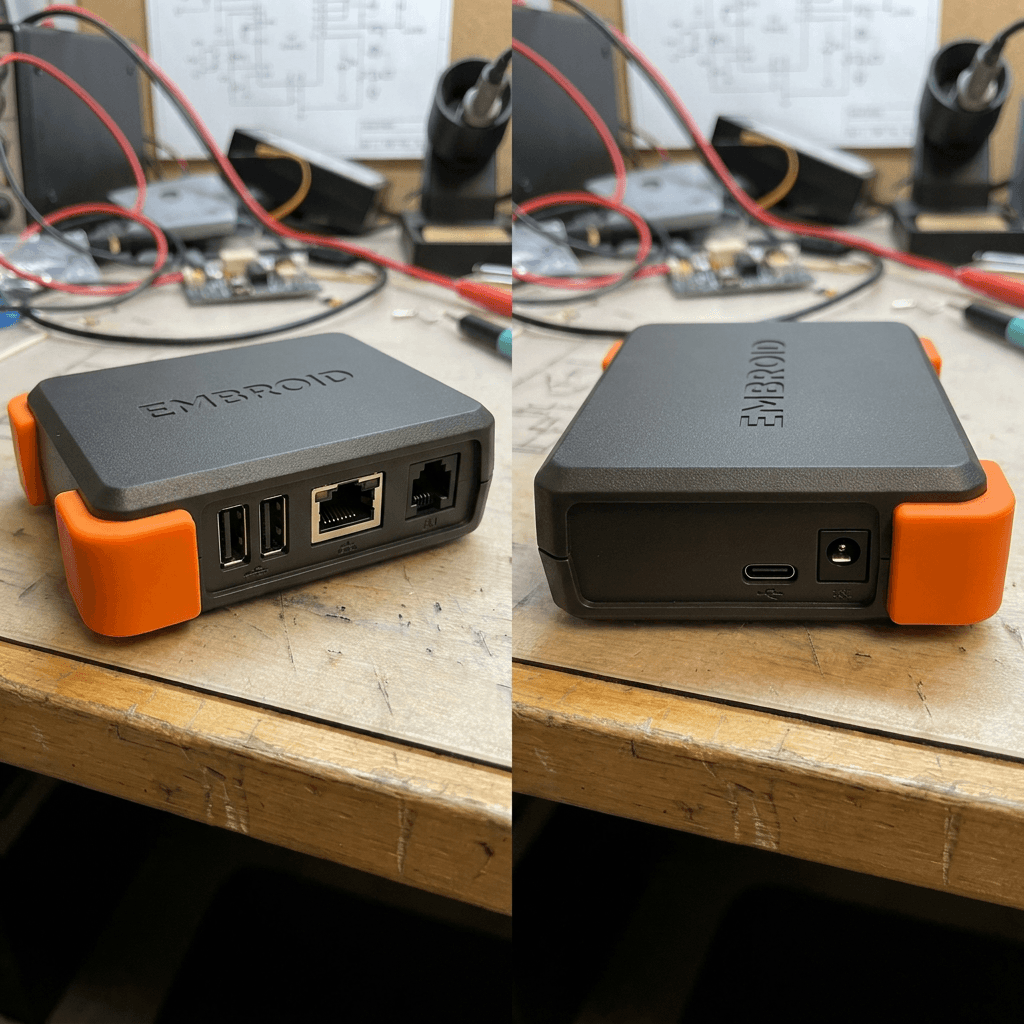
A dedicated node that replaces the spare-PC bench setup.
Basic is a compact always-on hardware bridge for one bench. It takes the place of the repurposed laptop or shoebox PC that's currently hosting your USB hub, JTAG probe, and power switch. Front-panel indicators show power, network, lease status, and error state at a glance.
- Hardware bridge for one bench, not a shared lab hub.
- Boots straight into a local control experience. No account needed for core workflows.
- Cloud relay, history, and team features are optional add-ons, not requirements.
Everything you need to run real hardware workflows
Replace the spare-PC bench setup
Leave Basic connected so the bench remains available without relying on a laptop that sleeps or reboots.
Control the physical layer
Switch USB, reset targets, cut power, control low-voltage outputs, capture serial, and trigger GPIO, all from one node.
Run one workflow at a time
A local job queue and one active lease keep access clear, predictable, and conflict-free.
Work locally or connected
Use local UI, CLI, MCP, and REST without an account, or enable cloud coordination for remote access and team workflows.
Scale to Pro when the lab grows
Move to Pro when you need more targets, more debug channels, scheduling, accessories, and richer observability.
A dedicated node for one bench.
Everything you need to drive a single bench from one small node, USB, power, serial, triggers, and status all on board.
- 2× downstream USB-C dataTarget devices, debug probes, or vendor adapters.
- 1× upstream USB-C host passthroughAttach to a workstation when you want pure passthrough mode.
- Switchable USB-C power outDrive or cut VBUS to a connected target.
- Barrel-jack DC input + switched DC outputFor targets with their own supply rails.
- Low-voltage trigger / relay outputDrive external relays, wireless mains accessories, or custom rigs.
- 3–4 GPIO linesReset, boot-mode, or custom signaling.
- 2× UART channelsCapture firmware logs from two interfaces concurrently.
- Wi-FiNo Ethernet required, connect to bench wireless.
- Status lightsPower, network, lease/activity, error state visible from across the room.
Works even when the cloud does not.
Local UI, CLI, MCP, REST, power control, job execution, logging, and recovery remain fully available without an Embroid account. Cloud connection adds remote relay, richer history, and team features, but it does not own the device.
- 01Local mode, reach the bench over your LAN, no account required.
- 02Connected mode, opt in to the cloud for remote access, team coordination, and synced history.
- 03Passthrough mode, attach Basic to a workstation and use it as a smart USB/power fixture.
# Local mode, same surface as Client
$ embroid devices list
$ embroid power cycle nrf52-04
$ embroid flash nrf52-04 ./firmware.bin
$ embroid serial tail nrf52-04
The bench earns its keep around the clock.
The same Basic node serves agent-driven development during the day and fills idle hours with scheduled regression and release work, Embroid coordinates whose turn it is.
A human or agent holds a lease and drives the bench end-to-end.
- Flash, run, observe, iterate
- Local MCP for agent loops
- Live serial and power streams
Between active sessions, Basic runs scheduled and triggered workflows on the same hardware.
- Nightly regression sequences
- Release smoke tests on every tag
- On-call field debug, wake the bench remotely
Basic is one bench, not a shared lab.
Basic runs one workflow at a time under a single active lease. It is designed for one-bench reliability, not multi-user coordination.
- One active lease / workflow at a time, if the bench is in use, the next operator queues locally.
- Two UART / debug channels and a modest GPIO count, enough for typical single-target work, not advanced parallel validation.
- Wi-Fi only, use Pro if you need wired Gigabit Ethernet or WPA Enterprise on lab networks.
- Multiple engineers need access to the same devices with scheduling, queueing, and resource locking.
- You need more serial / debug channels to validate across several targets in parallel.
- The lab network requires wired Gigabit Ethernet or WPA Enterprise authentication.
- You need richer local history, evidence capture, and audit trails across jobs.
- You want accessory expansion for thermal, camera, CAN / RS485, logic capture, or sensor workflows.
Who Embroid Basic is designed for
- One bench
- Small teams
- Remote debugging
- Always-on hardware access
Ready to try Embroid Basic?
A compact hardware node with switched USB, power control, serial capture, GPIO triggers, local control surfaces, and optional cloud coordination, so your bench stays available even when your laptop is closed.